The County of Maui Housing Navigator Program (HNP) provides ongoing support for wildfire-impacted Maui families, from disaster recovery to housing stability through rental assistance, housing navigation, case management, and individualized support.
October 2026 | FEMA FACT SHEET FS-073: DR-4724P-HI
FAQ: UpcomingRent Increase for Maui Wildfire Survivors Living in FEMA Temporary Housing Units
Survivors currently living in FEMA-provided temporary housing units will receive a 60-day notice about the next scheduled rent increase under the approved extension of assistance through February 28, 2027. This will be the third rent increase during this extension period.
Rental amounts for the third rent increase will be based on the U.S. Department of Housing and Urban Development Fair Market Rent, or HUD FMR, for Maui County. Beginning December 1, 2026, FEMA will charge all Direct Housing occupants 75% of the FY2027 HUD FMR for Maui County.
FEMA is gradually increasing rent requirements to help Direct Housing occupants prepare for market rental rates, support continued progress toward permanent housing, and move FEMA’s temporary housing mission toward closure, having provided three and a half years of temporary housing assistance to Maui survivors.
Since the disaster, FEMA provided temporary housing units for 1,281 displaced families on Maui. With support from state and local partners, more than two-thirds of these families have transitioned to permanent housing.
FEMA Recertification teams continue to meet regularly with occupants to help them work toward permanent housing solutions. These teams connect occupants with available resources, review program requirements, and remind them of important deadlines.
Q&A: Changes to Rental Payment
Q.When are Direct Housing rental rates set to change?
A. As of December 1, 2026, all applicable Direct Housing households will be charged 75% of the U.S. Department of Housing and Urban Development Fair Market Rent.
Q.What should the household do if they do not wish to pay the new rent amount?
A. If the household does not wish to pay the new monthly rent, they may submit an appeal by the deadline in the rent increase notification letter or move out of the FEMA unit by November 30, 2026. Households awaiting a final decision on their rental rate are required to pay the full rent amount until an appeal decision is made. Once the decision is made, FEMA will refund the difference if applicable.
Q.What are the HUD Fair Market Rental Rates?
A. The HUD Fair Market Rental Rates for Maui County per number of bedrooms are listed below. Beginning December 1, 2026, Direct Housing participants will be charged 75% of these rates.
Q.Can the rent increase again during the extension period?
A. The rent may continue to increase during the extension period. Prior to any additional increase, FEMA will notify the household at least 30 days before the new rental amount takes effect.
Q&A: Rental Payment Process
Q. How do participants receive their rent statement?
A. Households receive their rent statements at their current mailing address and can obtain their billing statements by signing into their FEMA account online and checking under current communications. It is the responsibility of the household to ensure their current mailing address on file with FEMA is accurate.
Q. How do participants send in their rent payment?
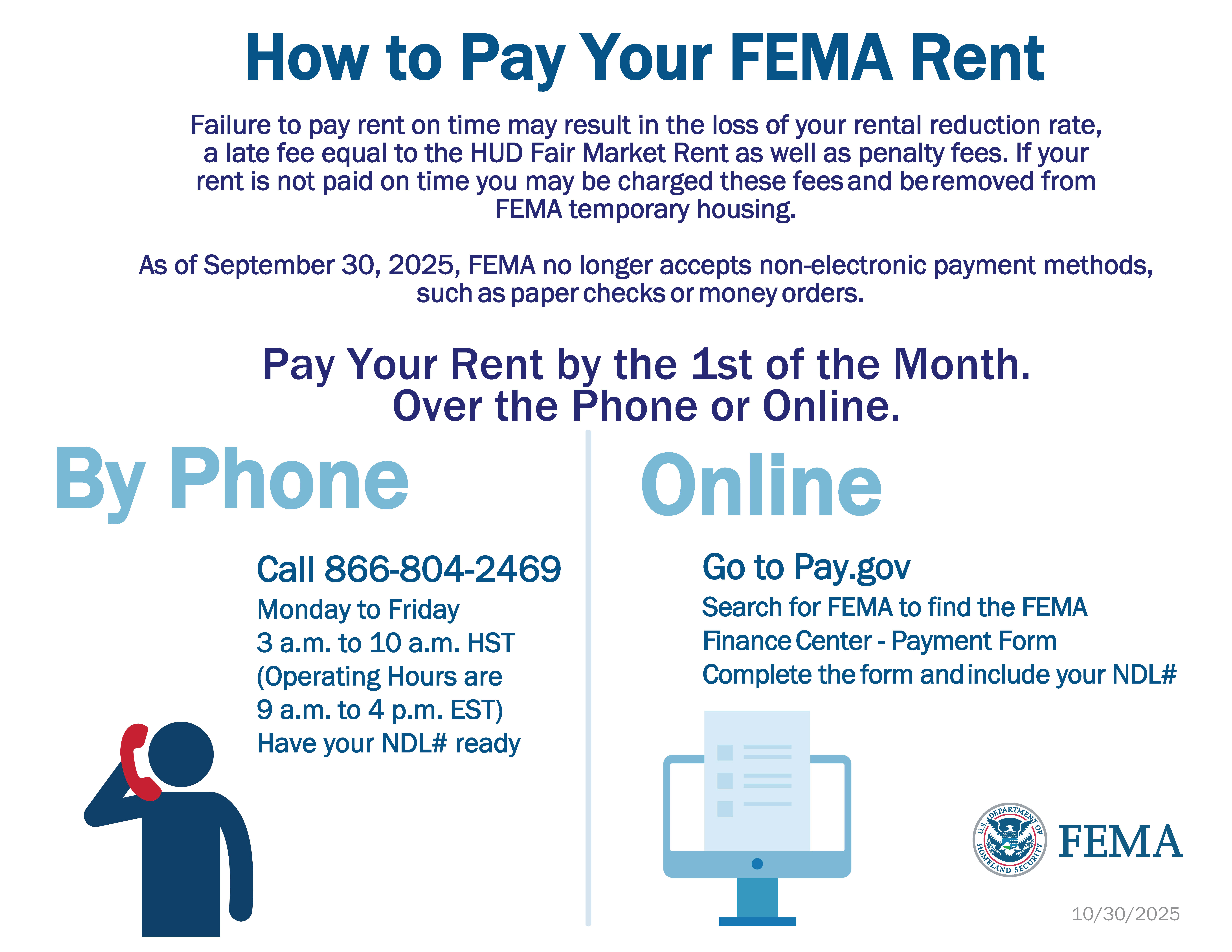
A. Survivors in Direct Housing can pay their rent over the phone or through electronic payment methods. For detailed payment instructions, please refer to the “How to Pay FEMA” page on FEMA.gov: https://www.fema.gov/about/payment
Q. When is the rent payment due?
A. Rent must be paid within 30 days from the 1st of every month.
Q. What if a participant makes a payment after 30 days?
A. Late rent payments may result in penalty fees and loss of housing eligibility.
Q. What if the survivor would like to move out of their FEMA temporary housing unit?
A. If the household has secured permanent housing or would like to leave their FEMA unit for another reason, they should notify their Recertification Advisor. If they vacate the unit by the end of the month, they are not responsible for the following month’s rent. FEMA does not prorate monthly rent. If they move out of their FEMA unit at any point during the month, they are responsible for the full amount of the rent for that month.
Q. Who do survivors contact if they have questions on how to pay?
A.Households should call FEMA Finance at 866-804-2469, Monday to Friday from 9 a.m. to 4 p.m. EST (EST is currently six hours ahead of Hawaiʻi time) or email FEMA-Finance-AccountsReceivable-Deposits@FEMA.dhs.gov. If you use video relay service, captioned service, or other communication services, please provide FEMA with the specific number assigned for that service.
Q&A: Appealing the Rental Amount
Q.What if the household cannot afford the rental amount?
A. The 60-day rent increase notification letter will include information on how to appeal and request a lower rental amount. Submitting an appeal does not guarantee it will be granted.
Q.How long do households have to submit an appeal to request a rent reduction?
A. Households have 60 days from the date of the rent increase notification letter to submit an appeal for a rent reduction. FEMA strongly encourages households to submit their appeal as soon as possible to allow adequate time for processing before the December 1, 2026 rent adjustment date. Delays in submitting appeal paperwork or submitting an appeal with missing documentation may result in a longer decision process. Households awaiting a final determination on their rental rate must continue to pay the full rent amount that month until a decision is reached.
Q.How do households submit an appeal to adjust their rental rate?
A. To submit an appeal, households must explain in writing why they cannot afford the stated rent and attach documents supporting their case.
In their appeal letter, households should detail their income and expenses, including their mortgage, property taxes, homeowners/renters insurance, and utilities such as electric, water and gas.
Examples of acceptable documents:
Federal W-2 forms (or current pay stubs) for all occupants over the age of 18.
A record of a current mortgage payment or rental agreement.
A copy of a current property tax bill or canceled check.
A copy of current insurance policy invoice or canceled check.
A copy of recent invoices or canceled checks for utility payments.
Without submitting relevant documentation with their appeal by the deadline, occupants cannot be considered for reduced rent.
Q.What happens if a household’s appeal is not processed by December 1, 2026?
A. Households awaiting a final decision on their rental rate are required to pay the full rent amount until an appeal decision is made. Once the decision is made, FEMA will refund the difference, if applicable.
Q.If households have questions about the rental requirement and the appeal process, who do they talk to?
A. Direct Housing households are encouraged to talk to their Rec
If you are a survivor of the 2023 Maui wildfires, and you are in FEMA’s Direct Housing Program, the following information may help guide you through the rental payment process.
Kako‘o Maui matches wildfire survivors with the right housing opportunities. These include Short- and Long-term Lease Programs, Host Housing Support Program, DHHL Wildfire Relief Program, and more.
The Hawai‘i Interim Housing Program (HIHP) is no longer accepting new applications as of December 15, 2024, and open applications needed to be submitted by January 15, 2025. Applicants who can demonstrate they were unable to meet the application closure date due to circumstances beyond their control may request to submit a late application. Late applications can be requested through March 17, 2025 by calling the HIHP Contact Center at 808-727-1550.
Please note that those who applied for HIHP prior to the closure of applications are not guaranteed placement in a unit. Please refer to the program’s website for more information.
The Hawai‘i Interim Housing Program (HIHP) assists those displaced by the Maui wildfires by placing survivor households in temporary state-sponsored housing.
HIHP is administered by the Hawai‘i Office of Recovery and Resiliency (HORR) in collaboration with the State of Hawai’i’s Department of Human Services (DHS) and Hawai’i Housing Finance and Development Corporation (HHFDC).
HIHP includes all State of Hawai‘i interim housing sites related to Maui wildfire recovery, including Hale ‘O Lā‛ie, formerly the Haggai Institute in Kihei, and Ka La’i Ola in West Maui, north of Lahaina.
Eligibility Requirements
You may be eligible for HIHP if:
You resided in Maui County prior to the disaster.
You are displaced from your permanent residence due to the Maui Wildfires, or
You faced disaster-related unemployment that resulted in the loss of your home.
If you are not sure if you are eligible for HIHP, you are still encouraged to apply.
Kā La‘i Ola temporary housing project features 450 furnished, prefabricated homes and 26 community buildings on state land in Lahaina designated for residential development.
The deadline to apply for the Hawai‘i Interim Housing Program (HIHP) has passed. Applicants who can demonstrate they were unable to meet the application closure date due to circumstances beyond their control may request to submit a late application. Late applications can be requested through March 17, 2025 by calling the HIHP Contact Center at 808-727-1550.
The Hale o La‘ie project, located at 175 E Lipoa Street in Kihei, features 175 furnished guestrooms, various amenities, and a convenient location in a mixed-use neighborhood. The facility will initially be operated as temporary housing for certain individuals and families displaced by last year’s wildfires.
The deadline to apply for the Hawai‘i Interim Housing Program (HIHP) has passed. Applicants who can demonstrate they were unable to meet the application closure date due to circumstances beyond their control may request to submit a late application. Late applications can be requested through March 17, 2025 by calling the HIHP Contact Center at 808-727-1550.
FAQs for State of Hawai’i Interim Housing Program (HIHP)
This program is for those displaced from their homes by the Maui Wildfires. Those experiencing homelessness can visit homelessness.hawaii.gov/help to get help.
We recognize that your household members may have changed following the wildfires. Your application should include all individuals you plan to live with if you are placed in an interim housing unit.
Eligibility does not guarantee placement in an interim housing unit. Eligible applicants will be matched with interim housing units based on availability.
The information you provide will be utilized to evaluate your needs and eligibility. Your household data will not be sold. Applicant information may be shared with State and Federal agencies, their contractors, nonprofit organizations, and other partner agencies for the purpose of providing assistance related to the 2023 Maui Wildfire Disaster.
Applying to HIHP is completely free. Applicants placed in an interim housing unit will not be asked to contribute to rent or utility payments through August 2025.
Yes. Applicants to HIHP are required to sign up for the Disaster Case Management Program (DCMP). DCMP is a FEMA-funded effort that allows trained case managers to collaborate with disaster survivors to develop a disaster recovery plan and to work together to address the unmet needs described in the plan. Applicants who have applied to DCMP but have not yet been assigned a case manager will still be eligible for HIHP.
Interim housing sites may be able to accommodate pets. Please describe your pets in the application so that a HIHP team member can match you to the interim housing unit that best meets your needs.
Households who need help applying to HIHP, including those with limited English proficiency, can contact the Call Center at 1-808-727-1550 for assistance.
You can apply by visiting this page or calling 1-808-727-1550 and completing the questions for your household. You will be required to register an account online with a valid email address to receive program updates and to provide required documentation. If you do not have an email address, you may call our contact center at 1-808-727-1550 for them to help create one for you.
If you have previously applied for assistance with FEMA or American Red Cross, some of your information may already be pre-populated in the application. Please review all information and complete any missing fields. When your application is complete, a member of the HIHP team will contact you to discuss the next steps.
The Hawai‘i Interim Housing Program (HIHP) assists those displaced by the Maui wildfires by placing survivor households in temporary state-sponsored housing. The program is administered by the Hawai‘i Office of Recovery and Resiliency (HORR) in collaboration with the State of Hawai‘i’s Department of Human Services (DHS) and Hawai‘i Housing Finance and Development Corporation (HHFDC). HIHP includes all State of Hawai‘i interim housing sites related to DR-4724-HI Maui Wildfires recovery, including Hale ‘O Lā‛ie, formerly the Haggai Institute in Kīhei, and Ka La‘i Ola in West Maui.
HIHP has two housing sites, Hale ‘O Lā‘ie, formerly the Haggai Institute, in Kihei, and Ka La‘i Ola in West Maui. More housing sites may be added to HIHP in the future. If approved for placement, a HIHP team member will work with you to match your household to an available housing solution that best meets your needs as units become available. The timeline for placement is dependent on unit availability.
Yes, everyone in your household 18 and older must complete a background check to qualify for HIHP. Background check results will be assessed on an individual and household basis.
Many interim housing units can accommodate access and functional needs. Please describe your household’s specific requirements in your application so a HIHP team member can find the housing solution that best meets your needs.


.jpg)







.svg)
.svg)